

HTTP Status Codes Explained: The Five Classes, 418, 451, and 402
Web developers see 200 OK, 404 Not Found, and 500 Internal Server Error every day. But why are HTTP status codes three digits, why does the first digit define a class, and is 418 I'm a teapot an official code? This article follows primary sources from early HTTP and 1992 design material to RFC 9110, HTTP Semantics, separating historical anecdotes from the current registry.
Japanese original published: 2026-05-02
Early HTTP had no status line
Tim Berners-Lee's early HTTP, later called HTTP/0.9, was extremely small. A request consisted of a line such as GET /path. The response had no headers and no status line; it returned only a body.
RFC 1945 describes the older response form with this grammar:
Simple-Response = [ Entity-Body ]Without a status line, a client could not distinguish success, redirection, conditional responses, and failures through the machine-readable contract used by modern HTTP. A body could explain a problem to a person, but it did not provide the current protocol structure.
From 1992 design documents to RFC 1945
Three-digit HTTP status codes did not first appear in RFC 1945. W3C documents from 1992 already describe three-digit codes and response classes, while a historical design note explicitly points to FTP's three-figure status codes as an example.
RFC 1945, written by Tim Berners-Lee, Roy Fielding, and Henrik Frystyk and published in May 1996, documented HTTP/1.0 and defined a response's first line as the Status-Line:
Status-Line = HTTP-Version SP Status-Code SP Reason-Phrase CRLF
Example: HTTP/1.0 200 OK
RFC 1945 documented the three-digit format and classification by the first digit. The practical advantage remains important: a recipient can determine an unfamiliar response's broad class from its first digit.
HTTP/1.0 documented 15 codes: 200, 201, 202, 204, 301, 302, 304, 400, 401, 403, 404, 500, 501, 502, and 503. Every one of those numbers remains listed in the current IANA HTTP Status Code Registry.
The five status-code classes
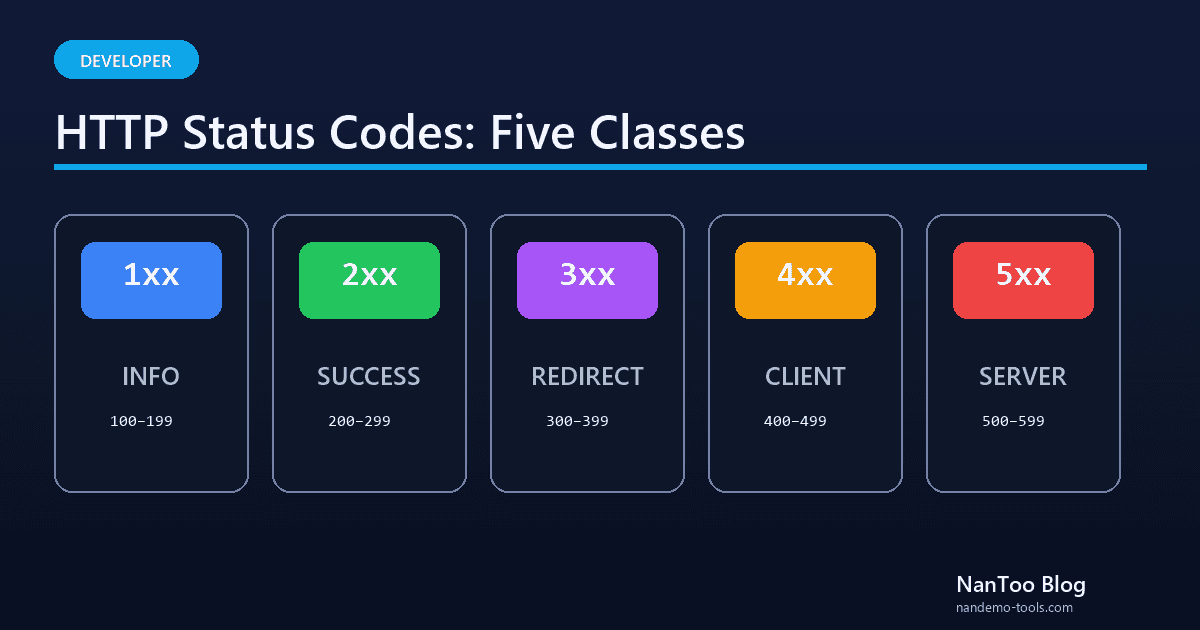
RFC 9110 §15 defines five classes according to the first digit:
Scroll horizontally if the table does not fit.
| Class | Range | Meaning | Examples |
|---|---|---|---|
| 1xx | 100–199 | Informational | 100 Continue, 101 Switching Protocols, 103 Early Hints |
| 2xx | 200–299 | Successful | 200 OK, 201 Created, 204 No Content |
| 3xx | 300–399 | Redirection | 301 Moved Permanently, 304 Not Modified |
| 4xx | 400–499 | Client Error | 400 Bad Request, 404 Not Found, 429 Too Many Requests |
| 5xx | 500–599 | Server Error | 500 Internal Server Error, 503 Service Unavailable |
The design supports forward compatibility. Under RFC 9110 §15, a client that does not recognize a status code treats it as equivalent to the x00 member of the same class. New codes can therefore communicate their broad outcome to older clients even when those clients do not understand the code's specific semantics.
An unfamiliar status code does not, by itself, prohibit cache storage. Storage is governed separately by RFC 9111 §3. An unfamiliar code can be stored when explicit response directives such as max-age and all other applicable conditions permit it, including no-store and shared-cache restrictions. For responses carrying must-understand, or with status 206 or 304, the cache must understand the status code. Recognizing a class is not unconditional permission to store or reuse a response.
How the HTTP specifications evolved
Scroll horizontally if the table does not fit.
| RFC | Date | Version | Role |
|---|---|---|---|
| RFC 1945 | May 1996 | HTTP/1.0 | Documented HTTP/1.0 with 15 status codes |
| RFC 2068 | January 1997 | HTTP/1.1 | First edition; added 100 Continue and persistent connections by default |
| RFC 2616 | June 1999 | HTTP/1.1 | Obsoleted RFC 2068; later obsoleted by RFC 7230–7235 and related documents |
| RFC 7230–7235 | June 2014 | HTTP/1.1 | Split the specification into six core documents |
| RFC 9110–9114 | June 2022 | HTTP | Separated semantics, caching, HTTP/1.1, HTTP/2, and HTTP/3; RFC 9110 defines shared semantics |
The 2022 revision is especially significant. RFC 9110 is not merely an HTTP/1.1 document: it defines HTTP semantics shared by HTTP/1.1, HTTP/2, and HTTP/3. The transport and framing can change while status-code meanings remain common.
418 (Unused): a code with an April Fools' history
418 I'm a teapot appeared in RFC 2324 on April 1, 1998. RFC 2324 is an Informational RFC, not an Internet Standard. It describes the fictional Hyper Text Coffee Pot Control Protocol, or HTCPCP.
The joke says that a teapot asked to brew coffee returns 418 I'm a teapot. The historical phrase is widely recognized, but the current IANA registry and RFC 9110 §15.5.19 label 418 as “(Unused)”. New HTTP implementations should not assign it an application meaning merely because the earlier joke exists.
402 Payment Required: reserved from early HTTP to today
402 Payment Required already appeared in a W3C status-code document from 1992 and was later included in the first HTTP/1.1 specification, RFC 2068. RFC 9110 §15.5.3 still marks it “reserved for future use.” Despite its long history, HTTP does not define an interoperable payment workflow for the code.
An API can assign 402 a private meaning for a failed payment or subscription state, but that does not make the meaning an HTTP standard. If you use it, document the API-specific contract instead of assuming clients will infer one universal behavior.
103 Early Hints: information before the final response
103 Early Hints was defined in the Experimental RFC 8297 in December 2017. It lets a server send selected hints before the final response is ready.
HTTP/1.1 103 Early Hints
Link: </style.css>; rel=preload; as=style
Link: </app.js>; rel=preload; as=script

(... the server prepares the final response ...)

HTTP/1.1 200 OK
Content-Type: text/html
...
A client can start processing the Link hints while the server prepares a final 200 OK. Intermediaries might not forward the informational response, and clients might ignore the hints, so correctness must never depend on receiving 103. Measure support and performance in the actual delivery path.
The IANA registry is the current source of record
IANA maintains the official HTTP Status Code Registry.
When checked on September 3, 2026, the registry displayed a last-updated date of September 15, 2025 and contained 64 individually registered codes. Code 104 was a temporary registration expiring on November 13, 2026. Counts, expiration dates, and assignments can change, so implementations should consult the current registry and the specification referenced by each entry.
Products sometimes use unregistered numbers as private extensions, but those numbers have no standardized HTTP meaning. A conforming client can still classify an unknown code by its first digit, yet it cannot infer the extension's application-specific semantics.
Summary
- Early HTTP, later called HTTP/0.9, had no status line.
- Three-digit codes existed in 1992 W3C material before RFC 1945 documented 15 codes for HTTP/1.0.
- The five classes let recipients handle unfamiliar codes at a broad level.
- RFC 9110 defines semantics shared by HTTP/1.1, HTTP/2, and HTTP/3.
- 418 is “(Unused)” in the current registry; 451 reports legal obstacles; 402 remains reserved for future use.
- 103 Early Hints can send hints before a final response, but correctness cannot depend on it.
References and sources
- RFC 9111 — HTTP Caching (§3) ↗
- W3C — Status codes in HTTP (historical 1992 document) ↗
- W3C — HTTP: The Response (historical 1992 document) ↗
- W3C — HTTP historical design notes ↗
- RFC 9110 — HTTP Semantics ↗
- RFC 1945 — Hypertext Transfer Protocol — HTTP/1.0 ↗
- RFC 2324 — Hyper Text Coffee Pot Control Protocol ↗
- RFC 7725 — An HTTP Status Code to Report Legal Obstacles ↗
- RFC 8297 — An HTTP Status Code for Indicating Hints ↗
- IANA — HTTP Status Code Registry ↗
Editorial note
This article was prepared with AI assistance and reviewed by an editor before publication. It may still contain factual errors, interpretation mistakes, or outdated information. Check the cited primary sources or official documentation before making an important decision.