

Degrees, Radians and Gradians: Angle Units and Their SI History
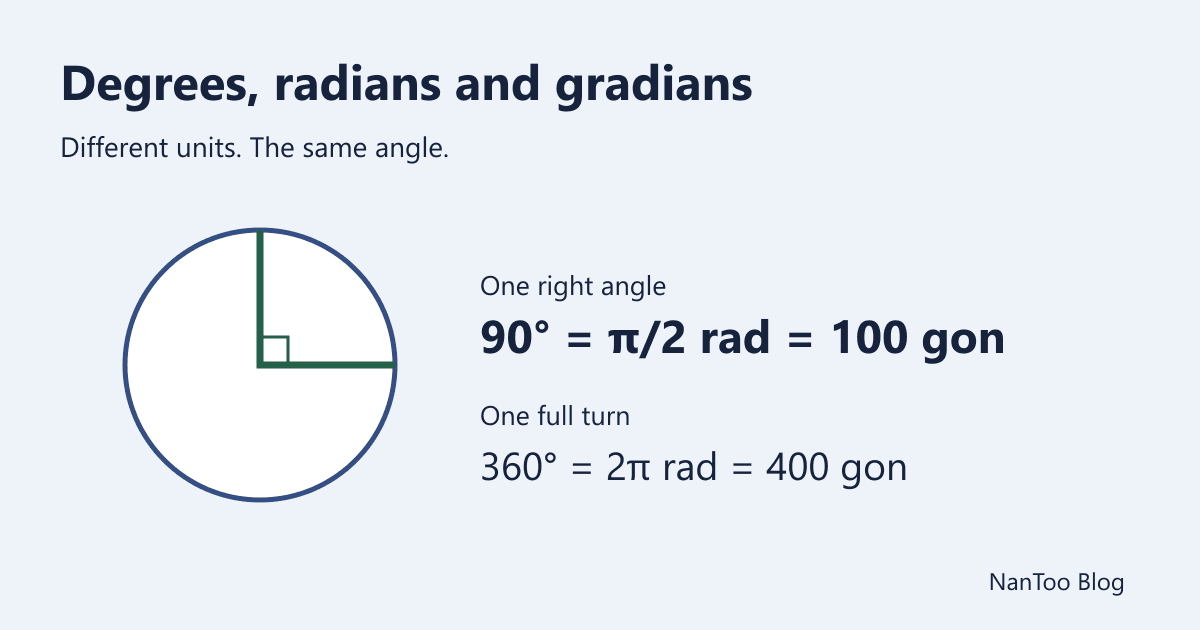
90°, π/2 rad and 100 gon all describe the same right angle. The number “90” alone does not tell you the angle without a unit or an agreed convention. Before entering a value into a calculator or passing it to a function, check the number and its unit together.
This guide explains how to convert these units, how the radian fits into the International System of Units (SI), and how to avoid mistakes with degrees–minutes–seconds and programming APIs.
Japanese original published: 2026-05-28
Different ways to measure one circle
Degrees divide a full turn into 360 parts; gradians divide it into 400. Thus 1 turn = 360° = 400 gon, and 1 gon = 0.9°. A right angle is 90° = 100 gon, while a half-turn is 180° = 200 gon. The symbol gon denotes the gradian, also called the grade.
Radians express an angle as the ratio of arc length to radius. A full circumference is 2π times the radius, so a full turn is 2π rad. To convert degrees to radians, multiply the value by π/180. To convert radians to degrees, multiply by 180/π.
The radian in SI history
When the SI was established in 1960, the radian and steradian belonged to a category called supplementary units. A 1980 recommendation by the International Committee for Weights and Measures (CIPM) interpreted them as dimensionless derived units, reflecting the treatment of plane angle as a ratio of lengths and solid angle as an area divided by a squared length. Resolution 8 of the 1995 General Conference on Weights and Measures (CGPM) approved this interpretation and abolished the separate supplementary-unit category.
“Dimensionless” does not mean that the unit symbol is useless. Writing rad still tells a reader that a number represents an angle in radians. It does not make the numerical value in degrees or gradians interchangeable with the value in radians.
Apply the sign to the whole degrees–minutes–seconds value
1° = 60′ = 3600″, and 1′ = 60″. Here ′ and ″ mean arcminutes and arcseconds, rather than minutes and seconds of time. For example, 30°15′ = 30 + 15/60 = 30.25°.
For a negative angle, apply the minus sign to the whole magnitude: −35°39′31″ = −(35 + 39/60 + 31/3600) ≈ −35.658611°. Calculating −35 + 39/60 + 31/3600 gives a different angle. If coordinates use N/S/E/W, check how those direction labels correspond to signs before converting.
Displaying more decimal places does not improve measurement accuracy. Converting an angular difference into distance also depends on location and the Earth model, so a coordinate’s number of decimal places alone cannot establish the actual accuracy of a GPS measurement.
A NATO mil is not a milliradian
The mil used here follows the NATO convention of 6400 mils per turn: 1 mil = 360/6400° = 0.05625°. A milliradian (mrad) is 0.001 rad. These are different units. Do not convert a value from the word “mil” alone: check how many divisions of a turn the source uses.
Unit conversion and angle normalization are separate operations. For example, converting 450° to radians gives 5π/2 rad. It does not automatically replace that value with π/2 rad, even though the two describe the same final direction after a full turn is discarded.
Calculator modes: DEG, RAD and GRAD
sin(90) is 1 in DEG mode, approximately 0.894 in RAD mode and approximately 0.988 in GRAD mode. That last result comes from 90 gon = 81°: it is not a right angle. In GRAD mode, a right angle is 100 gon.
The calculus limit lim(h → 0) sin(h)/h = 1 assumes that h is the numerical angle in radians. If h is a numerical value in degrees, the corresponding expression is lim(h → 0) sin(h × π/180)/h = π/180. Degrees can be used in calculus, but the conversion factor must be included.
Check each API’s input and output units
JavaScript’s Math.sin(x) and Math.cos(x) take angles in radians. To use 45°, convert the value first. Math.atan2(y, x) takes coordinate components, with y first, and returns an angle in radians.
OpenCV’s getRotationMatrix2D takes its angle argument in degrees. warpAffine takes a transformation matrix, not an angle directly. rotate takes an enumeration code such as ROTATE_90_CLOCKWISE; it does not accept an arbitrary angle. Check the individual parameter and return-value contracts even within one library.
const radians = 45 * Math.PI / 180;
console.log(Math.sin(radians)); // Approximately 0.7071067811865475
console.log(Math.atan2(1, 1) * 180 / Math.PI); // 45 degrees
Check the conversion before using the result
Start by identifying the input unit and converting any compound degrees–minutes–seconds value into one number. For instance, enter 30.25 as a value in degrees for 30°15′. A numeric field does not necessarily accept π, unit symbols, thousands separators or compound notation.
Check what a converter does when you change or swap units: some retain the input number and reinterpret it in the newly selected unit. Also check whether it preserves negative angles and multiple turns or normalizes them. These are interface choices, not changes to the conversion definitions.
A numerical result can contain rounding from π and floating-point arithmetic. More displayed digits do not create more accurate input data. Finally, distinguish angle conversion from trigonometric evaluation, angular velocity and parsing compound notation: a tool may support one without supporting the others.
References and sources
- NIST: NIST Guide to the SI, Appendix B.9: Factors for units listed by kind of quantity or field of science ↗
- BIPM: Resolution 8 of the 20th CGPM (1995) — Elimination of the class of supplementary units in the SI ↗
- BIPM: Recommendation 1 of the 69th CIPM (1980) — SI supplementary units (radian and steradian) ↗
- TC39: ECMAScript® 2027 Language Specification ↗(Continuously updated specification draft. See Math.sin, Math.cos and Math.atan2.)
- OpenCV: Geometric Image Transformations ↗
- OpenCV: Operations on arrays ↗
Editorial note
This article was prepared with AI assistance and reviewed by an editor before publication. It may still contain factual errors, interpretation mistakes, or outdated information. Check the cited primary sources or official documentation before making an important decision.