

Power Bank mAh and Wh: Voltage, Efficiency and Charging Estimates
Dividing a power bank's mAh rating by a device battery's mAh rating does not account for different voltage references or conversion losses. Match each capacity to its voltage, compare energy in Wh, and state which part of the energy path each efficiency assumption covers. The number of charges alone cannot establish whether a product is working normally or is faulty.
Japanese original published: 2026-06-02
Pair the capacity rating with its voltage
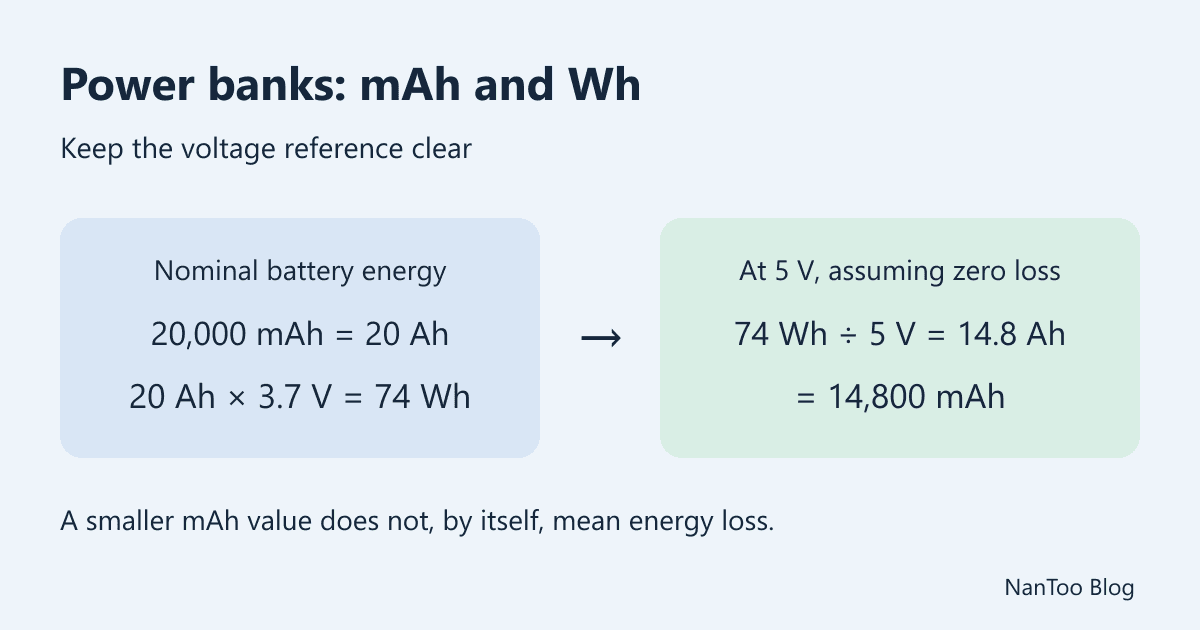
Ah and mAh measure electric charge; Wh measures energy. Using nominal ratings, the estimate is Wh = Ah × V. A battery rated at 20,000 mAh and 3.7 V therefore represents 20 Ah × 3.7 V = 74 Wh.
Use the cell voltage for a cell-based capacity rating and the pack voltage for a pack-based rating. Do not substitute the USB output voltage of 5 V. Nominal voltage depends on the battery specification, and voltage changes during discharge. Measured discharge energy is the accumulation of voltage × current over time; it is not guaranteed to equal the nominal Wh rating. The 3.7 V value here is an example. Use the product's specifications.
Changing the voltage reference is not an energy loss
At 5 V, 74 Wh corresponds to 74 ÷ 5 × 1000 = 14,800 mAh even with zero loss. The decrease from 20,000 mAh reflects the different voltage reference. No energy has been lost in this ideal conversion.
If we assume 85% efficiency from the battery to the output, the output energy is 74 × 0.85 = 62.9 Wh. At 5 V, that is 62.9 ÷ 5 × 1000 = 12,580 mAh, with a 15% energy loss in this model. The 85% figure is an assumption for the example, not a universal value for power banks. Here, we start with the nominal 74 Wh and assume that 85% is available at the specified output. Circuit efficiency alone does not determine available energy once ageing and discharge cut-off conditions are considered. Actual efficiency also depends on the circuit, load and temperature.
Estimate full charges and keep efficiency stages separate
A device battery rated at 3,000 mAh and 3.85 V has a nominal energy of 11.55 Wh. Dividing the 62.9 Wh available at the output by 11.55 Wh gives approximately 5.45 full-charge equivalents. This estimate excludes charging losses inside the device and energy consumed while it is in use. It is an energy comparison against the device battery's nominal capacity, not a count of charging sessions or a guarantee of five complete charges.
If we also assume 80% efficiency on the device side, the calculation becomes 74 × 0.85 × 0.80 ÷ 11.55 ≈ 4.36 full-charge equivalents. After applying both efficiencies, do not deduct the same losses again. Claims such as “only half the rated capacity is usable” or “it always gives three to four charges” are not universal rules.
The battery capacity converter lets you enter an efficiency from the battery to the specified output. If you change only the output voltage while keeping efficiency fixed, output-referenced mAh changes, but Wh and the estimated number of charges do not. The tool's charging estimate does not include device-side losses.
Series and parallel calculations use an ideal model
For identical cells connected in a balanced arrangement, the number of cells in series, S, multiplies voltage, while the number in parallel, P, multiplies Ah. In an ideal 3S2P arrangement of 3.7 V, 3,000 mAh cells, the pack has 11.1 V, 6,000 mAh and 66.6 Wh, using six cells. Pack Wh = cell mAh ÷ 1000 × cell V × S × P. With the same cells and cell count, nominal energy is unchanged by the series/parallel arrangement. This does not imply that the energy actually available in use will be identical.
This calculation is neither an assembly guide nor a safety assessment. It does not cover real designs involving different cell specifications or conditions, protection circuits or current limits.
What nominal ratings can and cannot tell you
Nominal Wh provides a basis for comparison, not a guarantee of the energy you can extract. Check the voltage reference and measurement conditions associated with the product's capacity rating. The tool also does not determine whether a battery may be taken on an aircraft. Check the battery label and specifications, then follow current guidance from your airline and the relevant public authorities.
The tool accepts numbers written with ASCII digits, including scientific notation, up to 32 characters per field. Efficiency ranges from 0 to 100%; series and parallel counts must each be integers from 1 to 1,000,000. Results are approximate and displayed to about 12 significant digits at most. See the tool for the detailed input ranges and how it handles values outside the representable range.
References and sources
- Texas Instruments: Non-Military Drone, Robot, or RC 2S1P Battery Management Solution Reference Design (Rev. A) ↗(TIDUBQ4A, revised July 2016. Section 9: nominal Wh and series/parallel notation.)
- learn.adafruit.com: Voltages | Li-Ion & LiPoly Batteries | Adafruit Learning System ↗(Nominal voltage and voltage changes during discharge.)
- www.faa.gov: Airline Passengers and Batteries | Federal Aviation Administration ↗(US FAA guidance on air transport. It is not a universal approval rule for every country or airline.)
Editorial note
This article was prepared with AI assistance and reviewed by an editor before publication. It may still contain factual errors, interpretation mistakes, or outdated information. Check the cited primary sources or official documentation before making an important decision.