

Digital watermarks and C2PA explained: detection, provenance and AI images
A logo, an invisible watermark and Content Credentials provide different kinds of evidence. A displayed label or detector result does not settle every question about an image’s content or rights.
This article explains embedding and detection, how to assess resistance to editing, and why provenance validation differs from deciding whether an image is true. Its discussion of Japanese rules retains the Japanese primary sources.
Japanese original published: 2026-05-11
Visible watermarks, invisible watermarks and C2PA do different jobs
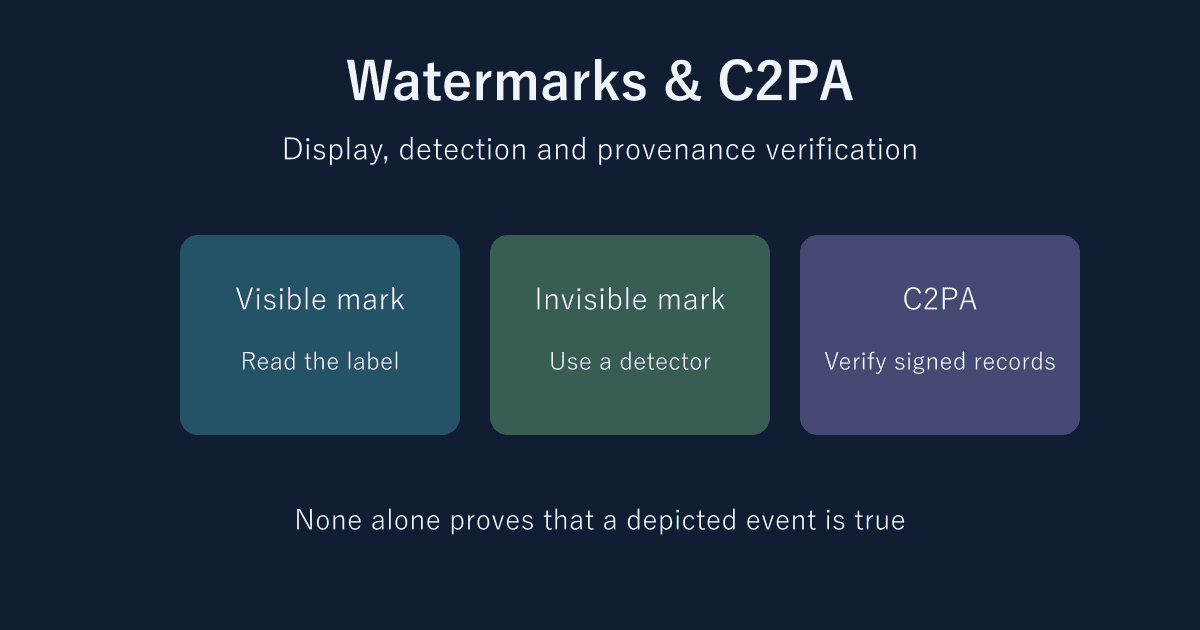
A visible watermark overlays text or a logo to communicate a name or usage information. An invisible watermark embeds a detectable pattern or message in the image signal. “Invisible” is a goal of minimizing perceptual impact, not a guarantee for every image or viewing condition.
C2PA handles signed records about creation and editing. It is distinct from embedding marks in pixels, although the two can be combined.
Scroll horizontally if the table does not fit.
| Mechanism | What you examine | What it cannot establish alone |
|---|---|---|
| Visible watermark | A displayed label | Whether its maker owns the rights |
| Invisible watermark | A signal or message found by a compatible detector | Whether an undetected image is a real photograph |
| C2PA | Signatures and the binding between records and content | Whether the depicted event is true |
These mechanisms do not necessarily prevent viewing or copying. Content Credentials should not be equated with DRM or proof of copyright ownership.
Design visible marks using the actual image
A corner logo leaves more of the subject unobstructed, but cropping away that area also removes the label. Central or repeated marks may remain in a crop more often, depending on spacing, size and the retained area. Tiling does not make removal impossible.
An opacity such as 30% does not determine visibility on its own. Background, text color, size and output resolution matter. Check readability over bright and dark areas, survival after downscaling, and whether viewers can still assess the work. A particular opacity is neither a universal recommendation nor a guarantee of removal resistance.
NanToo’s Japanese-language image watermark tool adds visible marks. Text or image overlays and placement controls are different functions from invisible watermark embedding or C2PA signing. Its PNG output does not carry over the original EXIF, location information or ICC metadata. Where provenance must be preserved, check a separate preservation workflow and keep the original before adding a mark.
An LSB example: a small change is not the same as robustness
Consider replacing the least significant bit of an 8-bit grayscale sample. This executable JavaScript teaching example assumes an integer sample from 0 to 255 and an embedded bit of 0 or 1.
const pixel = 214; // 11010110
const bit = 1;
const encoded = (pixel & 254) | bit;
console.log(encoded);     // 215
console.log(encoded & 1); // 1
The sample changes by zero or one, which alone guarantees neither imperceptibility nor secure concealment. One bit per pixel in a 1000×1000 image gives a raw capacity of 1,000,000 bits: 125,000 bytes, or 125 kB, approximately 122.1 KiB. Headers, error correction and synchronization reduce the space available for the actual message.
JPEG recompression or resizing with interpolation can change samples and disrupt simple LSB recovery. This does not mean every bit must always disappear. Hiding data, surviving edits and detecting alterations are different design goals.
DCT and DWT: a transform name does not establish robustness
The discrete cosine transform, or DCT, represents images in frequency components. Typical JPEG coding applies it to 8×8 blocks. DCT-domain watermarking changes selected coefficients and transforms the result back into an image. A schematic form is:
F = DCT(image)
F_marked = copy(F)
for each k in selected_coefficients:
    F_marked[k] = F[k] + alpha * pattern[k]
image_marked = IDCT(F_marked)
Unselected coefficients retain their original values. This is not a complete algorithm. Coefficient selection, normalization, quantization, pixel rounding and decoding still need to be defined. The units and suitable magnitude of alpha depend on the representation; 0.01–0.1 is not a general recommended range. Middle-frequency embedding only survives JPEG quantization under suitable strength and processing conditions.
The discrete wavelet transform, or DWT, uses low-pass and high-pass filters to separate an image into scales. Methods can use subbands such as LL, LH, HL and HH, but choosing DWT alone does not confer rotation or cropping resistance. Alignment and redundancy also matter. Complexity comparisons must distinguish fixed-size block processing from a whole-image transform.
Spread spectrum: distributing signals and measuring correlation
Spread-spectrum methods distribute a pattern over multiple components and examine correlation with a candidate image. Cox and colleagues’ 1997 paper is an influential example using perceptually important spectral components. Detection in that paper requires the original image and alignment with the image being tested. The same performance cannot be assumed for detectors that work without the original.
In a simplified binary model, let b∈{−1,+1}, p[i] be a pattern and alpha be the strength: X_marked[i]=X[i]+alpha*b*p[i]. Correlation also contains contributions from the host image X and subsequent edits. A detector may need an inconclusive region near its threshold.
If 262,144 available coefficients were divided equally among 64 bits, each would receive 4096 coefficients. That is an allocation calculation, not evidence of decoding at JPEG quality 50. Using a pattern or key also does not make a watermark’s presence impossible for others to detect.
SynthID detects supported watermarks, not every AI image
Google DeepMind introduced SynthID for pixel-level watermarking of Imagen images in 2023. The public explanation describes jointly trained embedding and detection models and acknowledges limits under extreme manipulation. It does not establish that every diffusion denoising step must inject a signal, or that there is nothing an attacker could remove.
No detected mark does not prove that a photograph is real. A compatible mark may never have existed, may have weakened during processing, or may fall outside the detector’s scope. Detection does not establish the truth of a caption or uploader’s account, either.
The 2024 explanation of text watermarking describes adjusted token selection during generation and statistical detection. Short predictable answers, extensive rewriting and translation can reduce effectiveness. “At least 200 tokens” is not a universal guarantee. Image and text watermarking do not necessarily have identical methods or availability.
C2PA verifies records and their connection to content
C2PA Content Credentials include assertions—recorded statements—and signatures. Validating records, signatures and their binding to an asset helps reveal changes and provides trust information about the signer. A credential need not include a human author’s name or a complete editing history.
Successful validation does not prove that an event in front of a camera, or a caption, is true. Consider the signer, the implementation producing the records and the scope of the included information. Inspecting the full provenance of ingredients depends on access to those materials.
Manifests can be handled externally as well as embedded. Soft bindings, such as watermarks or fingerprints, may help rediscover credentials after embedded records are lost. Rediscovery and cryptographic validation are separate steps; automatic recovery across every service is not guaranteed. Missing Content Credentials are not themselves evidence of a fake.
Test the delivery path: screenshots and camera capture differ
A digital screenshot captures displayed pixels. Photographing a screen adds optics, lighting, viewing angle and a camera sensor. Describing both as the same digital-to-analog-to-digital process confuses the test conditions.
Scroll horizontally if the table does not fit.
| Processing | Conditions to record | Results to check |
|---|---|---|
| JPEG resaving | Encoder, quality setting, number of saves | Quality, detection and false-positive rates |
| Resizing or cropping | Dimensions, interpolation, retained region | Synchronization and message recovery |
| Digital screenshot | Display scale and resolution | Survival of signal and provenance information |
| Printing and camera capture | Paper, lighting, distance and angle | Localization through decoding |
Include unwatermarked images to measure false positives. Report resistance to removal or alteration together with acceptable image quality and test conditions. Strong or weak ratings for entire method families are insufficient. Combining labels, detection and record validation does not eliminate the need to keep originals and check sources.
Japanese rules and a practical publishing check
This section introduces Japanese rules; it does not replace them with another jurisdiction’s law. Japan’s Ministry of Internal Affairs and Communications and Ministry of Economy, Trade and Industry publish AI business guidelines to guide organizational practices. Recommendations should not simply be presented as universal statutory duties or criminal penalties. Check editions and scope on the official publication page.
Japan’s Copyright Act distinguishes technological protection measures, technological measures restricting use, and rights management information. The definitions in Article 2 and the rights-management-information provisions in Article 113(8) have conditions and exceptions. Not every watermark removal can be declared a crime under a particular provision. Technical ability to remove information is separate from permission to use or alter a work.
Before publishing, keep originals and editing records, choose the information to display, and reopen a copy delivered through the actual destination. Check for names, locations or other information you do not want to disclose. Missing provenance is missing information, not immediate proof of a real photograph, AI generation or copyright infringement.
References and sources
- C2PA: Content Credentials : C2PA Technical Specification ↗(Version consulted: 2.5.)
- C2PA: C2PA FAQ ↗
- Google DeepMind: Identifying AI-generated images with SynthID ↗
- Google DeepMind: Watermarking AI-generated text and video with SynthID ↗
- arXiv: HiDDeN: Hiding Data With Deep Networks ↗
- Matthew Tancik et al.: StegaStamp — Invisible Hyperlinks in Physical Photographs ↗
- IEEE: Secure Spread Spectrum Watermarking for Multimedia ↗
- 経済産業省: AI事業者ガイドライン ↗
- e-Gov 法令検索: 著作権法 ↗
Editorial note
This article was prepared with AI assistance and reviewed by an editor before publication. It may still contain factual errors, interpretation mistakes, or outdated information. Check the cited primary sources or official documentation before making an important decision.