

GIF and LZW patents: how compression shaped the history of PNG
A familiar file format can become difficult to develop or distribute because of rights covering the compression technology inside it. GIF and LZW offer a notable example. The compression method described in Welch’s 1984 paper had already been the subject of a patent application. The licensing controversy involving CompuServe and Unisys in late 1994 then helped spur the development of PNG.
This article separates the compression algorithm, image format and software license, tracing LZW and the expiry of the relevant Unisys patents in 2003–2004. It is a historical explanation, not a current patent clearance assessment for a particular country or product.
Japanese original published: 2026-04-25
From LZ77 and LZ78 to LZW
The 1977 paper by Jacob Ziv and Abraham Lempel belongs to the LZ77 family, which refers back to sequences already encountered. LZ78, associated with their 1978 paper, builds a dictionary of sequences. DEFLATE, later used by PNG, combines LZ77 with Huffman coding; it is distinct from the LZW used in GIF.
In June 1984, Terry A. Welch published a description of fast dictionary compression based on LZ78. LZW stands for Lempel–Ziv–Welch. Publication of an algorithm does not mean that implementations are free of patent claims. Treating “publicly described” as “unrestricted to implement” misses the central issue in this history.
What LZW compresses: an ABABABA example
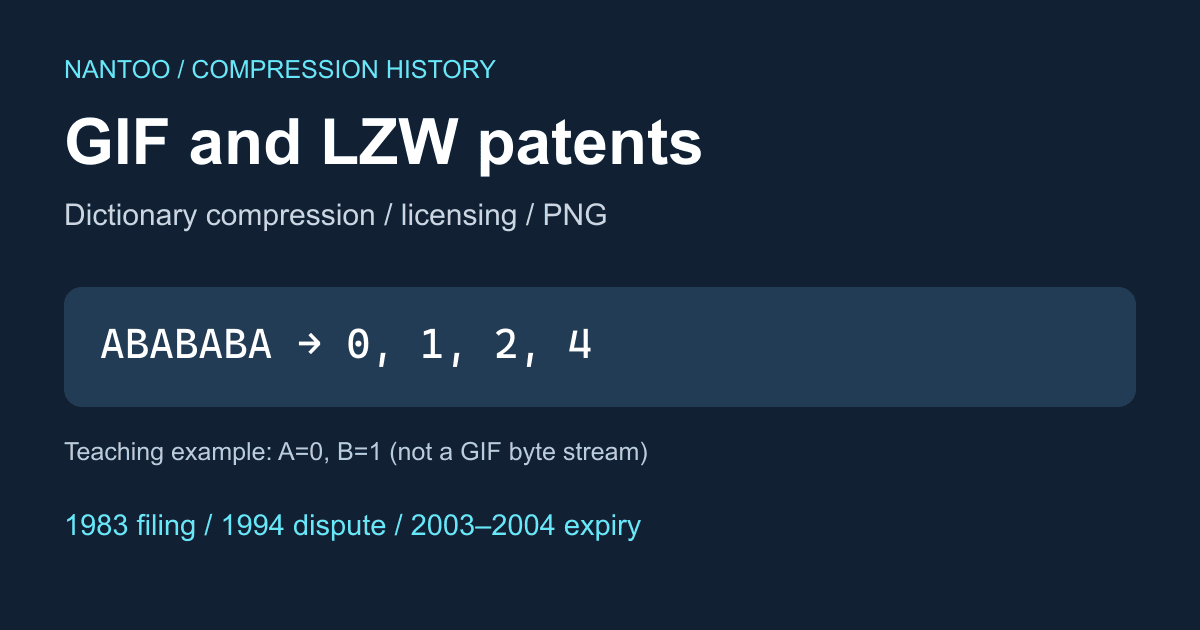
LZW represents recurring sequences with dictionary codes. If the encoder and decoder share the initial dictionary and update rules, the decoder can reconstruct the sequences without receiving the completed dictionary. This teaching example starts with A=0 and B=1. It is not a GIF byte stream.
Scroll horizontally if the table does not fit.
| Sequence represented by the code | Code | New dictionary entry |
|---|---|---|
| A | 0 | AB = 2 |
| B | 1 | BA = 3 |
| AB | 2 | ABA = 4 |
| ABA | 4 | No addition at the end of the input |
The output is 0, 1, 2, 4. The decoder emits A, B and AB while growing its dictionary. When it receives the final code 4 before that entry exists, it reconstructs ABA by appending the first symbol of the previous sequence, AB, to that sequence. This special case applies when the received code is the next code to be assigned.
Seven characters becoming four codes does not imply a file size of 4/7 of the original. Code widths, initialization and end codes, image headers and other overhead also matter. Short or poorly repetitive input can become larger.
LZW in GIF: not a fixed nine-bit code
CompuServe’s GIF87a specification is dated June 15, 1987. GIF applies LZW to a sequence of color-table indices rather than to the color values themselves. A color table has at most 256 entries. Although LZW is lossless, reducing a photograph to a limited palette can lose color information before compression begins.
Under GIF89a, a minimum code size of m gives an initial code width of m+1 bits, with a maximum of 12 bits. With m=8, codes start at nine bits, but that is not universal. Even a two-color image uses m=2. A Clear code resets the dictionary; an End of Information code ends the data. Reaching the dictionary limit does not require an immediate Clear code.
GIF87a already allowed multiple images in a data stream. GIF89a’s Graphic Control Extension supplies controls such as delays, transparency and disposal methods. Multiple-image storage itself was therefore not introduced for the first time in 89a.
The 1983 filing came before the 1984 paper
US Patent 4,558,302 names Welch as inventor and Sperry as the original assignee. It was filed on June 20, 1983, and the granted patent was published on December 10, 1985. The paper appeared in 1984; that was not the patent’s filing year. Following the 1986 merger of Sperry and Burroughs, the rights passed to Unisys.
Older US patents can be affected by transitional term rules, so a blanket calculation using today’s “20 years from filing” explanation is insufficient. The expiry dates below come from dates expressly stated in a contemporary licensing document. Google Patents’ automated legal-status field should not be treated as an individual legal opinion.
The late-1994 controversy and the start of PNG
PNG contributor Greg Roelofs identifies CompuServe’s announcement on December 28, 1994, as a turning point. Discussions with Unisys had begun earlier. The start of negotiations, the public announcement and the precise contract terms are different matters.
The central issue was patent licensing for software implementing the compression technology, not a tax on a filename extension. “GIF tax” was a nickname, not a tax regime. Licensing demands, including later demands involving websites, depended on the period, agreement and implementation used. They should not be reduced to a claim that every website displaying a GIF owed a uniform fee.
In early 1995, Thomas Boutell and other contributors began discussing a replacement for GIF. Avoiding the patent problem was one motivation; support for more colors and more flexible transparency also helped shape PNG.
Three different dates for PNG standardization
- October 1, 1996: PNG 1.0 became a W3C Recommendation.
- March 1997: RFC 2083 was published. It did not appear on the same date as the 1996 Recommendation.
- March 2004: ISO/IEC 15948:2004 was published. Its designation is not a 2003 edition.
PNG adopted DEFLATE, choosing a different compression format rather than waiting for the LZW patent to expire. RFC 1951 describes DEFLATE as a combination of LZ77 and Huffman coding.
PNG 1.0 did not include animation, so its original role as a GIF replacement centered on still images. That is no longer an enduring limitation of the standard: the PNG Third Edition W3C Recommendation of June 24, 2025 includes APNG animation. PNG transparency is not universally limited to eight bits either; the rules depend on color type and bit depth.
Regional expiry of the Unisys patents
The following dates are stated in the LZW notice within a 2005 License Agreement between Stellent and Guidance Software, filed with the SEC. This is a contemporary record about the specified Unisys patents, not a claim that we have independently re-examined every national patent register.
Scroll horizontally if the table does not fit.
| Scope | Expiry date |
|---|---|
| United States: US 4,558,302 | 2003-06-20 |
| Counterparts in the UK, France, Germany and Italy | 2004-06-18 |
| Japanese counterparts | 2004-06-20 |
| Canadian counterpart | 2004-07-07 |
Source: Stellent Chicago Sales, Inc. / SEC: License Agreement (LZW notice).
The US expiry date is not a worldwide expiry date. Nor does this table establish that all rights held by other companies or covering improvements disappeared in 2004. The same notice mentions separate patents and applications concerning improvements.
Choosing images today: format and software licenses
Image selection need not be dictated by GIF’s history. Compare colors, transparency, still versus animated content, destination support, encoding time and file size. WebP or AVIF may produce smaller files, but not invariably one fifth or one tenth the size of GIF. Compare the same material, quality, resolution and frame count. See our WebP, AVIF and JPEG comparison for related considerations.
NanToo’s Japanese GIF animation maker uses gif.js, which is distributed under the MIT license. Patent expiry and the copyright license of an implementation are separate issues. Distribution of a library can still carry notice requirements, and the rights to the input images also matter.
Keep the format, compression and rights separate
LZW encodes recurring sequences as dictionary codes; GIF is an image format that incorporates it. The 1983 filing, 1984 paper, 1985 grant and late-1994 licensing announcement are distinct events. So are PNG’s subsequent development and its standardization milestones in 1996, 1997 and 2004.
The expiry of the relevant Unisys patents in 2003–2004 was an important milestone, but it did not erase software licenses or copyright in images. This article explains technology and patent history in general terms. For a legal assessment of a particular contract or product, identify the implementation and jurisdiction and consult an appropriate professional.
References and sources
- IEEE / Computer: A Technique for High-Performance Data Compression ↗
- IEEE / IEEE Transactions on Information Theory: A universal algorithm for sequential data compression ↗
- IEEE / IEEE Transactions on Information Theory: Compression of individual sequences via variable-rate coding ↗
- patents.google.com: US4558302A - High speed data compression and decompression apparatus and method - Google Patents ↗
- RFC Editor: RFC 2083: PNG (Portable Network Graphics) Specification Version 1.0 ↗
- ISO: ISO/IEC 15948:2004 — Information technology — Computer graphics and image processing — Portable Network Graphics (PNG): Functional specification ↗
- web.archive.org: Unisys Patents Expired, But Patent Threats Continue ↗
- CompuServe: Graphics Interchange Format, Version 89a ↗
- Greg Roelofs / PNG: The Definitive Guide: History of the Portable Network Graphics Format ↗
- W3C: PNG (Portable Network Graphics) Specification Version 1.0 ↗
- W3C: Portable Network Graphics (PNG) Specification (Third Edition) ↗
- Stellent Chicago Sales, Inc. / SEC: License Agreement ↗(LZW notice in a 2005 agreement; not a patent office determination of legal status.)
- RFC Editor: RFC 1951: DEFLATE Compressed Data Format Specification version 1.3 ↗
- GitHub: GitHub - jnordberg/gif.js: JavaScript GIF encoding library ↗
- CompuServe: Graphics Interchange Format ↗(GIF87a specification dated June 15, 1987.)
Editorial note
This article was prepared with AI assistance and reviewed by an editor before publication. It may still contain factual errors, interpretation mistakes, or outdated information. Check the cited primary sources or official documentation before making an important decision.