

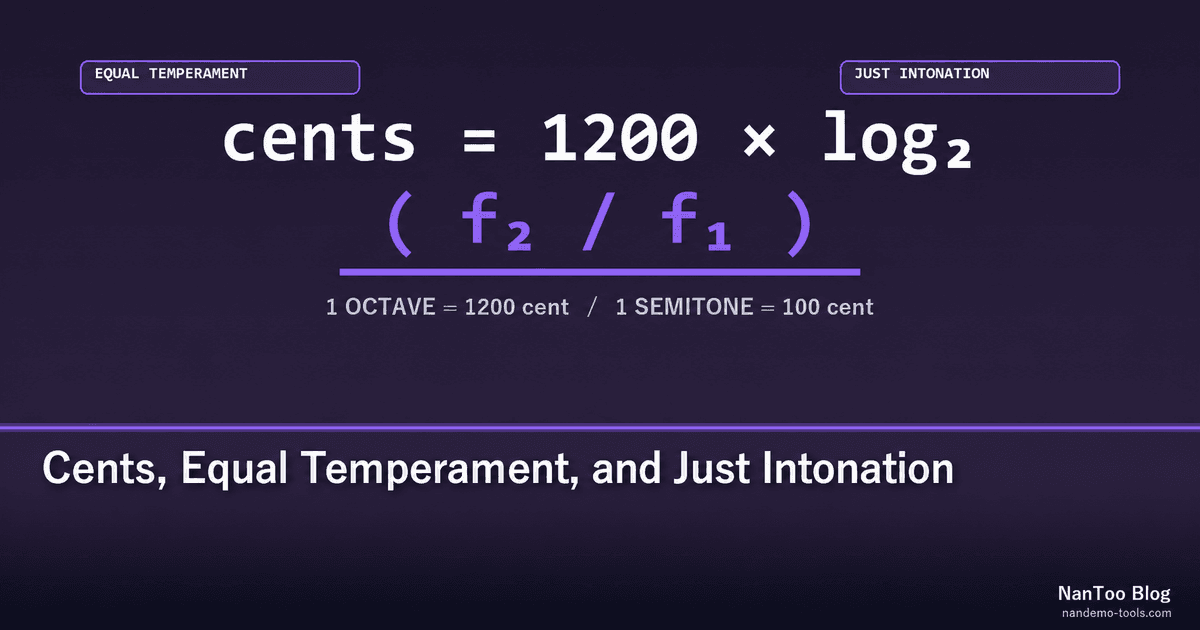
Cents, Equal Temperament, and Just Intonation
The “+5 cents” or “−12 cents” shown by a tuner is a logarithmic measure of pitch distance. An octave contains 1,200 cents, so one semitone in 12-tone equal temperament contains 100 cents. The frequency ratio for one cent is 2^(1/1200).
Japanese original published: 2026-04-19
The mathematical definition of a cent
Alexander J. Ellis presented and used the cent scale in his nineteenth-century comparative work on musical scales. For two frequencies f₁ and f₂, the interval is:
cents = 1200 × log₂(f₂ / f₁)- An octave, with a frequency ratio of 2:1, is 1,200 cents.
- An equal-tempered semitone is 100 cents.
- One cent is a ratio of
2^(1/1200) ≈ 1.0005778.
Because the scale is logarithmic, the same number of cents represents the same musical interval at any frequency, even though the absolute difference in hertz changes.
12-tone equal temperament
Most modern pianos, fretted guitars, and electronic tuners use 12-tone equal temperament. It divides the octave into twelve equal frequency ratios:
semitone ratio = 2^(1/12) ≈ 1.059463Using A4 = 440 Hz, as specified by ISO 16, selected notes are:
Scroll horizontally if the table does not fit.
| Note | Frequency | Cents from A4 |
|---|---|---|
| A4 | 440.00 Hz | 0 |
| A♯4 | 466.16 Hz | 100 |
| B4 | 493.88 Hz | 200 |
| C5 | 523.25 Hz | 300 |
| E5 | 659.26 Hz | 700 |
| A5 | 880.00 Hz | 1,200 |
The advantage is consistency: every key has the same interval pattern. The compromise is that most intervals differ slightly from simple whole-number frequency ratios.
Just intonation
Just intonation builds intervals from simple ratios such as 3:2, 4:3, and 5:4.
Scroll horizontally if the table does not fit.
| Interval | Just ratio | Cents | Difference from 12-TET |
|---|---|---|---|
| Octave | 2/1 | 1200.000 | 0 |
| Perfect fifth | 3/2 | 701.955 | +1.955 |
| Perfect fourth | 4/3 | 498.045 | −1.955 |
| Major third | 5/4 | 386.314 | −13.686 |
| Minor third | 6/5 | 315.641 | +15.641 |
The difference in a major third is large enough to be audible in exposed harmony. Singers and flexible-pitch instruments can adjust toward simple ratios, reducing beats and producing a more settled chord.
Why equal temperament became the practical standard
A set of just ratios works around a particular tonal centre. Move to a distant key and the same fixed pitches no longer preserve all of those ratios. Keyboard and fretted instruments therefore need a compromise that works in every key.
Equal temperament makes each semitone identical and slightly narrows the pure 3:2 fifth. Earlier “well temperaments” also allowed performance in many keys but retained different interval colours by key; Bach's Well-Tempered Clavier should not be treated as proof that he used today's mathematically equal 12-tone system.
How small a pitch difference can people hear?
Pitch discrimination depends on frequency, sound level, duration, timbre, musical context, training, and the test method. Controlled research has found lower frequency-discrimination thresholds in trained musicians than in non-musicians, but there is no single cent value that applies to every listener and sound.
A tuner reading is therefore not an absolute verdict on musical quality. A sustained unison exposes small offsets more clearly than a brief note in a complex mix, and performers may deliberately adjust intervals away from equal temperament.
Practical uses
- Compare a recorded pitch with a tuning reference.
- Detune doubled tracks by a few cents to widen a sound.
- Measure the difference between equal-tempered and just intervals.
- Design microtonal scales such as 22- or 31-tone equal divisions.
- Describe pitch bends and tuning offsets independently of octave.
NanToo's Chord Progression Player lets you hear chord progressions and transpose them directly in the browser.
Summary
cents = 1200 × log₂(f₂/f₁).- An octave is 1,200 cents; an equal-tempered semitone is 100 cents.
- Equal temperament supports every key with one consistent compromise.
- Just intonation uses simple ratios and can produce cleaner sustained harmony.
- Audibility depends on the listener, sound, and musical context.
References and sources
Editorial note
This article was prepared with AI assistance and reviewed by an editor before publication. It may still contain factual errors, interpretation mistakes, or outdated information. Check the cited primary sources or official documentation before making an important decision.