

Equal Temperament vs Just Intonation: Why a Piano C Major Chord Is Slightly Off
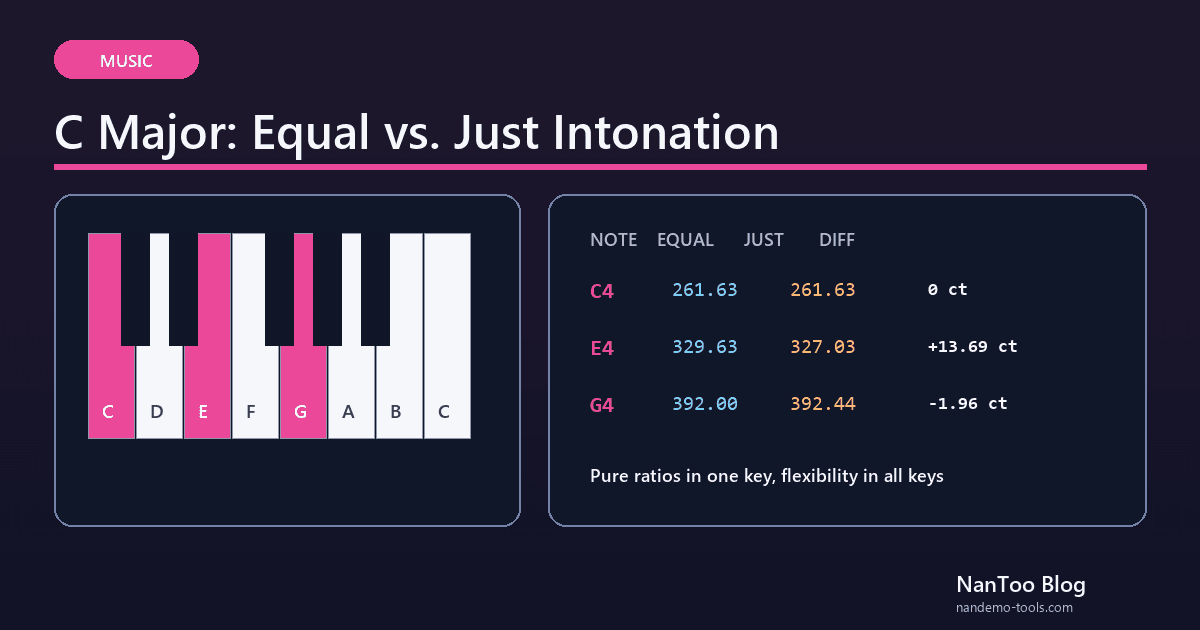
In theoretical 12-tone equal temperament, the E of a C–E–G major chord is about 13.7 cents sharper than a pure 5:4 major third. This is not a defect: it is part of a system that keeps the same interval structure in every key. In practice, singers and variable-pitch instruments can adjust intervals by context, while real pianos add further departures through stretch tuning.
Japanese original published: 2026-05-04
A 4:5:6 just major triad
With A4 = 440 Hz, equal-tempered C4 is approximately 261.63 Hz. Using its unrounded value as the reference, a 5-limit just major triad uses the ratios 1:5/4:3/2:
C4 ≈ 261.63 Hz
E4 ≈ 327.03 Hz
G4 ≈ 392.44 Hz

C : E : G = 4 : 5 : 6
Low-order partials then coincide: the fifth partial of C aligns with the fourth partial of E, and the third partial of C aligns with the second partial of G. Not every partial coincides, and real piano strings are inharmonic because of stiffness.
The same chord in 12-tone equal temperament
12-tone equal temperament divides the octave into twelve equal frequency ratios of 2^(1/12). With A4 = 440 Hz:
Scroll horizontally if the table does not fit.
| Note | Equal temperament | Just intonation | Difference from just |
|---|---|---|---|
| C4 | 261.63 Hz | 261.63 Hz | 0 cents |
| E4 | 329.63 Hz | 327.03 Hz | +13.69 cents |
| G4 | 392.00 Hz | 392.44 Hz | −1.96 cents |
The cent difference between two ratios r1 and r2 is 1200 × log2(r1/r2). Whether a listener notices a difference depends on frequency, timbre, duration, level, musical context, and training. This table is a theoretical A4 = 440 Hz model, not a claim that every key on a real piano has exactly these frequencies.
Partial beating in the major third and fifth
For the equal-tempered major third, E4's fourth partial is approximately:
329.63 × 4 = 1318.52 HzC4's fifth partial is approximately 1308.15 Hz, so the two components differ by about 10.38 Hz. Their interaction is one physical contributor to the audible difference between equal-tempered and pure major thirds.
For the fifth, equal-tempered G4's second partial and C4's third partial differ by about 0.89 Hz. Perception still depends on partial strength, decay, instrument inharmonicity, and listening conditions.
Why fixed twelve-note systems require compromise
A representative 5-limit just C major scale can make more than one local triad pure; for example, G–B–D can also form a 4:5:6 triad within that scale. The difficulty appears when one fixed set of twelve pitches must support every key and modulation.
Twelve pure 3:2 fifths do not equal seven octaves:
(3/2)^12 / 2^7 ≈ 1.013643
1200 × log2((3/2)^12 / 2^7) ≈ 23.46 cents
This difference is the Pythagorean comma. The ratio 81/80, about 21.51 cents, is the syntonic comma between a Pythagorean major third and a pure 5:4 third. These mismatches show why one fixed twelve-note keyboard cannot make every fifth and every major third pure at once.
Equal temperament distributes the compromise uniformly: every fifth is about 1.96 cents narrow and every major third about 13.69 cents wide, while transposition preserves the same interval pattern.
A short history of tuning and temperament
Scroll horizontally if the table does not fit.
| System | Historical outline | Design emphasis |
|---|---|---|
| Pythagorean tuning | Ancient onward | Pure 3:2 fifths; wide major thirds |
| Meantone temperament | 15th–17th centuries | Purer major thirds in a restricted set of keys |
| Well temperaments | 17th–18th centuries | Circulating unequal systems that make all keys usable with different interval colours |
| 12-tone equal temperament | Calculated by the late 16th century; adoption varied by region and instrument | Equal semitone ratios and invariant transposition |
Zhu Zaiyu described a highly accurate equal-temperament calculation in his 1584 New Theory of Musical Temperament. Scholarship also describes related European calculations from the late 16th and early 17th centuries. Calculation, application to instruments, and widespread adoption are distinct historical questions.
Adoption of 12-tone equal temperament expanded in the 19th century and later, but there is no single universal date across all regions and instruments. Well temperament and equal temperament are distinct concepts; the title The Well-Tempered Clavier does not specify that Bach required modern 12-tone equal temperament.
Real instruments do not fit one binary choice
A piano has fixed pitches during performance, but it can be tuned to historical temperaments. Modern piano tuning generally targets equal-tempered relationships while stretching high notes upward and low notes downward to accommodate string inharmonicity.
- Unfretted strings: players can adjust pitch continuously according to melody, harmony, and the ensemble.
- Voice and choir: singers may move chords toward simple ratios, but melodic direction and accompaniment also matter.
- Wind instruments: embouchure, air, fingering, and triggers allow instrument-dependent adjustment.
- Guitar: frets impose an approximately equal-tempered layout, while finger pressure and setup introduce smaller variations.
Performance intonation is therefore not exhausted by the labels “equal temperament” and “just intonation.”
Historically informed performance and subjective language
Words such as “warm,” “pure,” “muddy,” and “lifeless” express judgements, not universal acoustic facts. The measurable interval differences and the listener's preference should be kept separate.
Historically informed performance (HIP) uses surviving notation, treatises, instruments, and other evidence to investigate historical technique, pitch, and temperament. It is not merely a synonym for playing period instruments: historically informed techniques can also be applied on modern instruments.
Meantone or unequal well-tempered harpsichord chords can sound clearly different from 12-tone equal temperament. Neither is universally “correct”; each tuning system optimises different musical possibilities.
Summary
- The theoretical equal-tempered C–E major third is about 13.69 cents wider than 5:4.
- The equal-tempered C–G fifth is about 1.96 cents narrower than 3:2.
- Beating between nearby partials is one contributor to the audible difference.
- The Pythagorean and syntonic commas prevent one fixed twelve-note set from making all relevant intervals pure.
- Real piano stretch tuning, variable-pitch performance, and historical temperaments add further context.
References and sources
- Duffin (2007) — How Equal Temperament Ruined Harmony ↗
- Barbour — Tuning and Temperament: A Historical Survey ↗
- Cho (2003) — The Discovery of Musical Equal Temperament in China and Europe ↗
- Sethares — Tuning, Timbre, Spectrum, Scale ↗
- Simon Fraser University Sonic Studio — Just Tuning ↗
- N. H. Fletcher (1999) — The Nonlinear Physics of Musical Instruments ↗
- Music Theory Online — Discrete Fourier Transform and Bach's Good Temperament ↗
- Zurich University of the Arts — Historical Performance Practice ↗
Editorial note
This article was prepared with AI assistance and reviewed by an editor before publication. It may still contain factual errors, interpretation mistakes, or outdated information. Check the cited primary sources or official documentation before making an important decision.