

BPM to Delay Time: Note Values, Tap Tempo, and LFO Rates
You are setting a delay or reverb pre-delay in your DAW and need to know how many milliseconds an eighth note lasts. BPM—beats per minute—gives you the starting point. This guide uses one quarter note per beat, a common DAW tempo convention, to calculate note durations, dotted and triplet values, delay timing, and LFO rates. It also explains why two tap-tempo tools can return different results from the same taps.
Japanese original published: 2026-05-08
From BPM to milliseconds per beat
BPM (beats per minute) measures how many beats occur in one minute. It is used to specify tempo in songs, metronomes, and digital audio workstations.
BPM alone does not identify the note value assigned to a beat. Throughout this article, a beat means a quarter note. Use a positive, finite BPM value. For example, a 6/8 tempo marking of 60 dotted-quarter-note beats per minute corresponds to 90 quarter-note beats per minute at the same musical speed. Check the note symbol in the tempo marking, as well as the time signature and the pulse you hear.
Milliseconds per quarter-note beat = 60,000 ÷ BPM
The constant 60,000 comes from 60 seconds per minute and 1,000 milliseconds per second:
Scroll horizontally if the table does not fit.
| BPM | One quarter-note beat | Illustrative tempo label |
|---|---|---|
| 60 | 1,000 ms | Adagio |
| 90 | 667 ms | Andante |
| 120 | 500 ms | Allegretto |
| 140 | 429 ms | Allegro |
| 174 | 345 ms | Vivace |
Durations in this table are rounded to the nearest millisecond. The tempo labels follow the display categories in NanToo's BPM Tap tool, currently available in Japanese. They are guides, not a universal standard: BPM ranges associated with Italian tempo terms vary by period, composer, and reference.
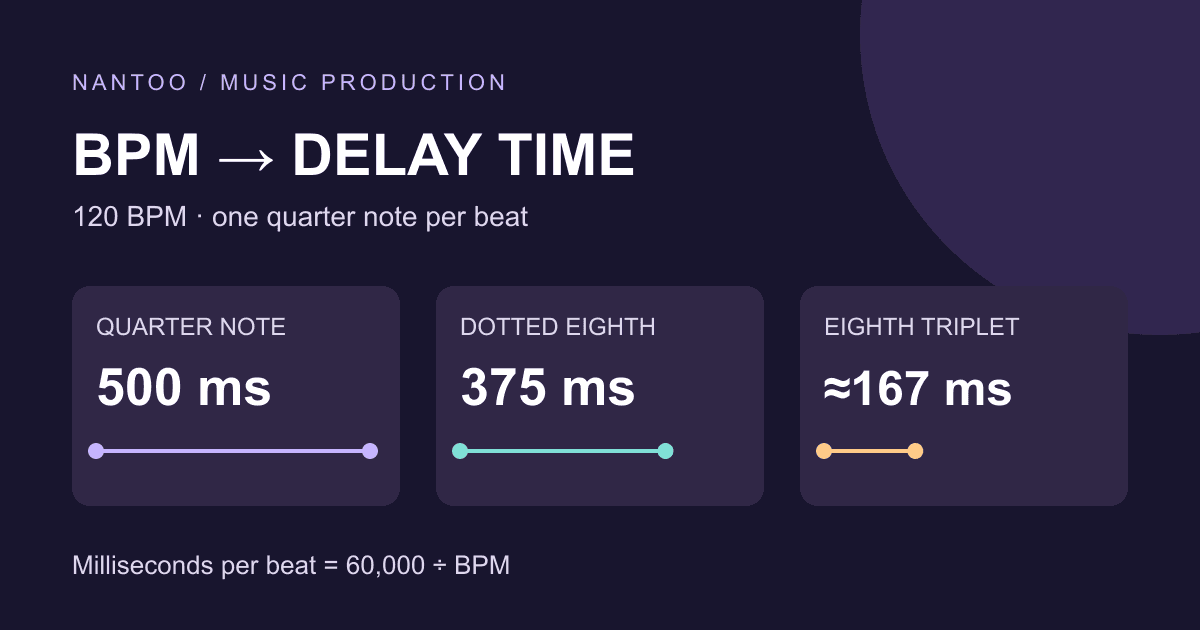
At 120 BPM, one quarter note lasts exactly 500 ms. A half note lasts 1,000 ms and an eighth note lasts 250 ms, making this a convenient tempo for checking the calculations.
Note durations: whole notes to thirty-second notes
Once you know the duration of a quarter note, multiply or divide it to find other straight note values:
Scroll horizontally if the table does not fit.
| Note value | Quarter-note beats | Formula | At 120 BPM |
|---|---|---|---|
| Whole note | 4 | 60,000 ÷ BPM × 4 | 2,000 ms |
| Half note | 2 | 60,000 ÷ BPM × 2 | 1,000 ms |
| Quarter note | 1 | 60,000 ÷ BPM | 500 ms |
| Eighth note | 1/2 | 60,000 ÷ BPM ÷ 2 | 250 ms |
| Sixteenth note | 1/4 | 60,000 ÷ BPM ÷ 4 | 125 ms |
| Thirty-second note | 1/8 | 60,000 ÷ BPM ÷ 8 | 62.5 ms |
For a note written as a fraction 1/n of a whole note, the general formula is duration in ms = 60,000 ÷ BPM × (4 / n). Set n to 4 for a quarter note, 8 for an eighth note, or 16 for a sixteenth note. The quarter-note beat assumption still applies.
Dotted notes and triplets
Dotted and tuplet values extend the straight-note calculations using simple ratios.
Dotted notes: multiply by 1.5
A dot adds half of the original note's duration, so a dotted note lasts 1.5 times as long. Two dots add one half and then one quarter of the original value, giving 1.75 times its duration.
At 120 BPM, a dotted quarter note lasts 500 × 1.5 = 750 ms, and a dotted eighth note lasts 250 × 1.5 = 375 ms.
Triplets: multiply by 2/3
A triplet fits three notes into the duration normally occupied by two notes of the same value. Each note therefore lasts 2/3 of its straight-note duration.
At 120 BPM, a quarter-note triplet lasts 500 × 2/3 ≈ 333 ms, and an eighth-note triplet lasts 250 × 2/3 ≈ 167 ms. These examples are rounded to the nearest millisecond.
For a quintuplet that fits five notes into the duration of four notes of the same value, the multiplier is 4/5. A sixteenth-note triplet lasts 2/3 of a straight sixteenth note, so six fit into one quarter-note beat. Tuplet ratios depend on how many normal note values the group replaces; check the notation's bracket and number.
How tap tempo estimates BPM
Tap tempo estimates a pulse from a series of button presses. You can use it to follow a live performance or estimate the tempo of a recording. The basic steps are:
- Record the timestamp of each tap.
- Calculate the intervals between consecutive taps.
- Choose a representative interval and calculate BPM = 60,000 ÷ interval in ms.
The choice of representative interval matters. An arithmetic mean includes every interval and is affected by unusually long or short gaps. A median is less sensitive to a few extreme values, but it cannot identify the intended musical beat on its own.
NanToo's BPM Tap uses the arithmetic mean of up to the latest eight intervals. It displays 20–300 BPM to one decimal place and starts a new measurement after a gap longer than three seconds. The tap function in BPM ⇔ Delay Time uses the median of up to the latest eight intervals. It displays whole-number BPM from 30 to 300 and starts a new measurement after a gap of three seconds or longer. These two tools are currently available in Japanese. Their different estimators, ranges, rounding, and reset rules can produce different readings from the same taps.
For example, five taps produce four intervals of [502, 498, 510, 495] ms:
- Arithmetic mean: (502 + 498 + 510 + 495) / 4 = 501.25 ms → 119.7 BPM.
- Median: sort the intervals and average the middle two: (498 + 502) / 2 = 500 ms → 120 BPM.
Which estimator is more useful depends on your purpose and how the taps vary. Treat a tap result as an estimate, rather than precise analysis of the recording. If the reading is unstable, try four to nine taps on a steady pulse.
Be clear about what each tap represents. For the note-duration tables here, tap once per quarter note. Within a tool's display range, tapping twice as fast on eighth notes gives roughly twice the displayed BPM; tapping once every two beats gives roughly half. If you tap dotted-quarter-note beats in 6/8, convert that rate to quarter-note BPM before using the formulas.
Research on sensorimotor synchronization examines variation in tap intervals, anticipation, and error correction. Repp's 2005 review surveys that field. These browser tools estimate tempo from input timestamps; they are not research measurement instruments.
BPM, hertz, and LFO cycle length
BPM counts beats per minute. Hertz (Hz) counts cycles per second. If one cycle lasts exactly one beat:
Frequency in Hz = BPM ÷ 60
At 120 BPM, one cycle per beat means 2 Hz; at 60 BPM, it means 1 Hz. To set an LFO (low-frequency oscillator) to a different note duration, use that duration as its full cycle period: Hz = 1,000 ÷ period in ms.
At 120 BPM, one cycle per quarter note is 2 Hz, one cycle per eighth note is 4 Hz, and one cycle per bar of 4/4 is 0.5 Hz.
More generally, at a steady tempo with a quarter note as the beat, a cycle lasting k beats has a rate of Hz = BPM ÷ (60 × k). Matching the rate alone does not guarantee that the LFO's peaks or troughs line up with the song's beats. Check phase, retrigger, and host-sync settings separately.
The 20–300 BPM range in BPM Tap is a tool display range. It is not a perceptual boundary between rhythm, continuous sound, and pitch: perception also depends on factors such as timbre and stimulus duration.
A quick reference for production
Use these formulas with a positive, finite quarter-note BPM value:
Scroll horizontally if the table does not fit.
| Quantity | Formula |
|---|---|
| 1/n note duration in ms | 60,000 ÷ BPM × (4 / n) |
| Dotted note duration in ms | Straight-note duration × 1.5 |
| Triplet note duration in ms | Straight-note duration × 2/3 |
| LFO rate in Hz, one cycle per k beats | BPM ÷ (60 × k) |
| BPM Tap estimate | 60,000 ÷ mean of up to the latest eight intervals in ms |
| BPM ⇔ Delay Time tap estimate | 60,000 ÷ median of up to the latest eight intervals in ms |
These calculations help you set delay times and LFO rates manually. For reverb pre-delay or compressor release, a note duration is a starting point for adjustment. Equipment timing definitions and the source material affect the result, so matching a number does not guarantee the best sound. At an awkward tempo such as 137 BPM, calculate a few candidate values, then listen and adjust.
References and sources
- University of Puget Sound — Music Theory for the 21st-Century Classroom: Dots and Ties ↗
- University of Puget Sound — Music Theory for the 21st-Century Classroom: Tuplets ↗
- Apple — Tape Delay in Logic Pro for Mac: tempo sync and delay time ↗
- Apple — Sampler LFO overview in Logic Pro for Mac: note values, phase, and key triggering ↗
- Repp, B. H. (2005). Sensorimotor synchronization: A review of the tapping literature. Psychonomic Bulletin & Review, 12(6), 969–992. ↗
- Lerdahl, F. & Jackendoff, R. (1983). A Generative Theory of Tonal Music. MIT Press. ↗
- Roads, C. (1996). The Computer Music Tutorial. MIT Press. General background on computer music. ↗
- Patel, A. D. (2008). Music, Language, and the Brain. Oxford University Press. ↗
Editorial note
This article was prepared with AI assistance and reviewed by an editor before publication. It may still contain factual errors, interpretation mistakes, or outdated information. Check the cited primary sources or official documentation before making an important decision.