

3d6 vs. 4d6 Drop Lowest: D&D Ability Score Probabilities Explained
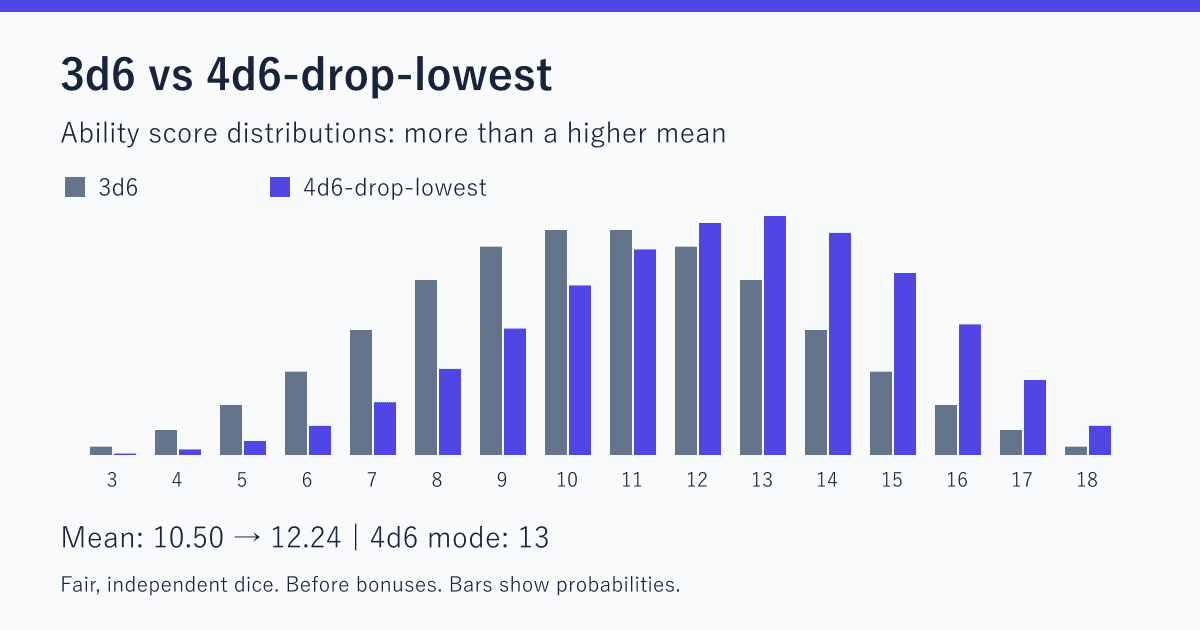
3d6 means adding three six-sided dice. 4d6 drop lowest means rolling four and adding the highest three. The latter raises the mean from 10.50 to about 12.24, but it does more than shift the same distribution to the right. This guide compares one score and a set of six scores, assuming fair, independent dice. All figures are before background or other ability-score increases, with no rerolls or minimum-total house rules.
Japanese original published: 2026-05-30
Keep editions and historical claims separate
Ability scores can be generated by rolling dice or by using fixed values. Historical descriptions should not be treated as rules for every edition. The first-edition AD&D Dungeon Masters Guide dates to 1979, so attributing its ability-generation methods to a “1978 DMG” gets the year wrong. This article does not infer a universal history of standardization or the designers’ motives. It uses the verifiable 2014 and 2024 rules as its reference points.
The 2014 Basic Rules present rolling four d6s and keeping the highest three, along with the standard array; point buy is a variant available at the DM’s discretion. The 2024 character-creation rules and SRD 5.2.1 list standard array, random generation, and point cost, with the GM able to specify a method. Rolling 4d6 is not mandatory at every table.
The calculations below exclude increases associated with race in the 2014 rules or background in the 2024 rules. The 3d6 distribution is a mathematical baseline; applying the 5e modifier formula to it does not mean that all older editions used that formula.
Exact enumeration: 216 outcomes versus 1,296
With distinguishable dice, 3d6 has 6³ = 216 ordered outcomes and 4d6 has 6⁴ = 1,296. They are equally likely under the assumption that each face has probability 1/6 and the dice are independent. If several dice tie for the lowest result, discard only one of them.
function dist4d6drop() {
  const counts = Array(19).fill(0);
  for (let a = 1; a <= 6; a++)
    for (let b = 1; b <= 6; b++)
      for (let c = 1; c <= 6; c++)
        for (let d = 1; d <= 6; d++) {
          const dice = [a, b, c, d].sort((x, y) => x - y);
          counts[dice[1] + dice[2] + dice[3]]++;
        }
  return counts;
}
const counts = dist4d6drop();
const mean = counts.reduce((sum, count, score) => sum + count * score, 0) / 1296;
console.log(mean); // 12.244598765432098
This code performs exhaustive enumeration. Ordinary convolution of sums alone does not implement the “drop lowest” operation. After finding the distribution for one score, convolution can combine six independent scores into a total distribution. Counts are exact; the decimals shown in this article are rounded, not simulation estimates.
One score: a mode of 13 and a mean of about 12.24
Scroll horizontally if the table does not fit.
| Statistic | 3d6 | 4d6 drop lowest |
|---|---|---|
| Mean | 10.500000 | 12.244599 |
| Standard deviation | 2.958040 | 2.846844 |
| Mode | 10 and 11 | 13 |
| Probability of 18 | 1/216 ≈ 0.463% | 21/1296 ≈ 1.620% |
| Probability of 16 or more | 10/216 ≈ 4.630% | 169/1296 ≈ 13.040% |
| Probability of 9 or less | 81/216 = 37.500% | 227/1296 ≈ 17.515% |
The mean increases by about 1.744599. While 3d6 is symmetric, 4d6 drop lowest is left-skewed, with a longer tail toward low scores. Similar standard deviations do not imply identical shapes. There are 172 outcomes producing 13 and 160 producing 14, so 13 is the only mode.
A score of 18 requires at least three sixes. Exactly three sixes occur in 20 ordered outcomes, and four sixes in one more: 21 in total. The probability is exactly 3.5 times the 3d6 probability. Also, if you add a fourth die to the same first three dice, the highest-three sum cannot be lower than the original three-die sum. This explains why the distribution favors higher scores; it does not guarantee that one player will beat another when they roll separately.
The probability that all six scores are at least 13
The probability of a single score of at least 13 is 56/216 for 3d6 and 632/1296 for 4d6 drop lowest. For six independent repetitions of the same method, raise that probability to the sixth power.
Scroll horizontally if the table does not fit.
| Event | 3d6 | 4d6 drop lowest |
|---|---|---|
| One score is at least 13 | 25.925926% | 48.765432% |
| All six are at least 13 | About 0.030367% | About 1.344846% |
The ratio is about 44.3. These correspond to roughly one qualifying set in 3,293 and one in 74, but generating 74 sets does not guarantee a qualifying set. If five players each generate one set using 4d6 drop lowest, the probability that at least one qualifies is 1 − (1 − 0.013448457…)⁵ ≈ 6.55%. That is not a promise that a group will encounter one within a few campaigns. Rerolling until a condition is met changes the model.
Expected modifiers are not a complete measure of character power
Under the 5e formula, an ability modifier is floor((score − 10) / 2). Rounding down matters for negative values too: scores of 3, 9, 13, and 18 yield −4, −1, +1, and +4. To calculate the expected modifier, weight each possible modifier by its probability. Do not simply apply the formula to the mean score.
Scroll horizontally if the table does not fit.
| Before ability-score increases | 3d6 | 4d6 drop lowest |
|---|---|---|
| Expected modifier for one score | 0 | About +0.873457 |
| Expected sum of six modifiers | 0 | About +5.240741 |
These are averages over many sets; an actual sum of modifiers is an integer. A character does not add +5.24 to each roll. A check uses the modifier for the relevant ability. Class, score assignment, skills, and proficiency affect the practical result. Summing modifiers does not produce a bonus that can be directly compared with proficiency or the contribution of another character.
Standard array and 27-point buy
The standard array is 15, 14, 13, 12, 10, and 8. Its total is 72 and its modifier sum, before increases, is +5. Point buy uses the following costs for scores from 8 through 15.
Scroll horizontally if the table does not fit.
| Score | 8 | 9 | 10 | 11 | 12 | 13 | 14 | 15 |
|---|---|---|---|---|---|---|---|---|
| Cost | 0 | 1 | 2 | 3 | 4 | 5 | 7 | 9 |
Exhaustively enumerating ordered six-score allocations that spend all 27 points gives 12,282 allocations. Score totals range from 69 to 75, and modifier sums from +3 to +7. For example, 15/15/15/8/8/8 totals 69 with a +3 modifier sum; 13/13/13/12/12/12 totals 75 with +6; and 14/12/12/12/12/12 totals 74 with +7.
Point buy is a choice, not a random process with an implied probability distribution. Without a model of how players choose, there is no justified claim that its “average total” is 72–73. The standard array’s +5 modifier sum is numerically close to the 4d6 expectation, but that does not establish the designers’ intention. Fixed methods avoid rolling variance; equal totals still do not guarantee equal effectiveness.
Where does your total fall? Define the percentile first
Let S be the total of six independent 4d6-drop-lowest scores. Its minimum is 6 × 3 = 18 and its maximum is 6 × 18 = 108. Here we report the cumulative probability P(S ≤ x): the proportion of totals at or below x. In a discrete distribution, including or excluding ties changes a percentile, so the definition matters.
Scroll horizontally if the table does not fit.
| Total x | Proportion at or below x |
|---|---|
| 60 | About 3.452% |
| 73 | About 49.403% |
| 74 | About 55.075% |
| 80 | About 84.219% |
| 90 | About 99.519% |
The mean total is about 73.468, while the median is 74: the first total whose cumulative probability exceeds 50%. The probability of exceeding 90 is about 0.481%, a different quantity from the proportion at or below 90. A house rule that rerolls totals of 60 or less would affect about 3.452% of initially generated sets, but the resulting distribution would no longer be the table above.
To calculate the total distribution, combine six copies of the single-score count distribution: start with one copy, convolve with another copy five times, then divide by 1296⁶. This total exceeds JavaScript’s safe-integer range, so exact counting requires BigInt or equivalent arithmetic. Convert to decimal probabilities only at the end.
NanToo’s Japanese dice-probability calculator supports NdS+M within its documented limits, including 3d6 and 3d8+5. It does not directly support dropping the lowest die. Use the code and counts in this article for that operation. For related background, see our Mersenne Twister guide on random-number generators and their limits. Calculating probabilities and choosing the style of play your table enjoys are separate decisions.
Rules attribution
This article summarizes the SRD ability-generation rules and adds original probability calculations and commentary.
This work includes material from the System Reference Document 5.2.1 (“SRD 5.2.1”) by Wizards of the Coast LLC, available at https://www.dndbeyond.com/srd. The SRD 5.2.1 is licensed under the Creative Commons Attribution 4.0 International License, available at https://creativecommons.org/licenses/by/4.0/legalcode.
References and sources
Editorial note
This article was prepared with AI assistance and reviewed by an editor before publication. It may still contain factual errors, interpretation mistakes, or outdated information. Check the cited primary sources or official documentation before making an important decision.