

The Metric System and the 2019 SI Redefinition: From Artefacts to Constants
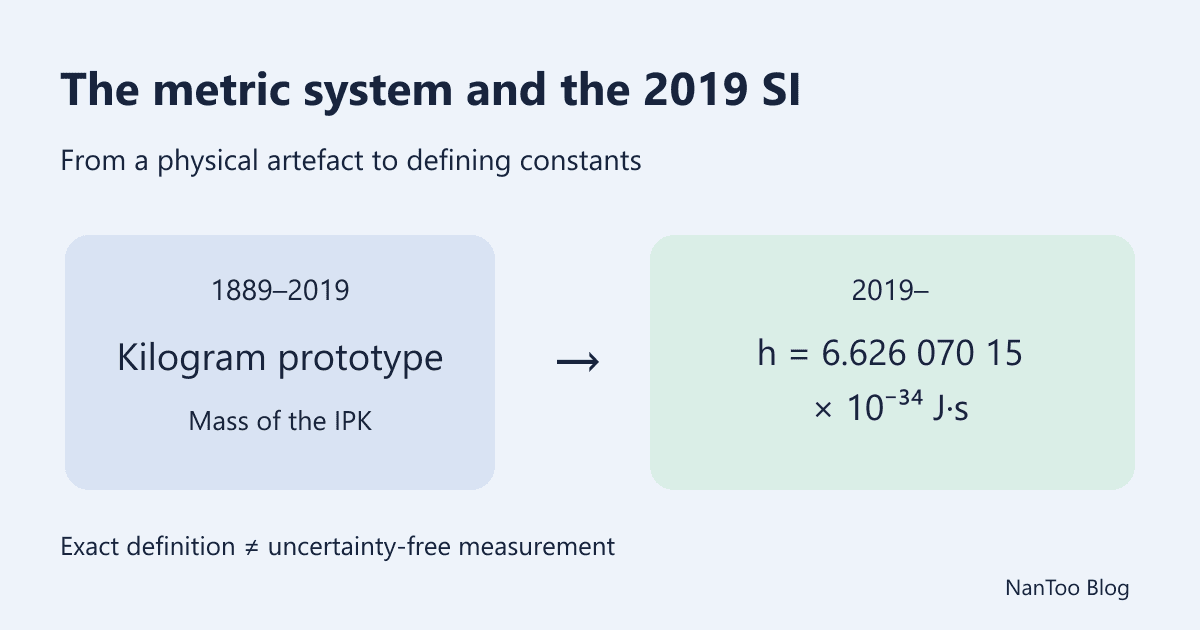
On 20 May 2019, the kilogram ceased to be defined by the mass of the International Prototype of the Kilogram. The revised International System of Units (SI) defines units by fixing the numerical values of seven defining constants. Four units changed their underlying basis in particular: the kilogram, ampere, kelvin and mole.
An exact definition does not make a weighing measurement free of uncertainty. This guide follows the history of the metric system and explains how definitions become practical measurements. The section on Japanese legislation is presented specifically as an example from Japan.
Japanese original published: 2026-05-22
1799: Standards inspired by the Earth and water
The metric system took shape during the French Revolution. The idea behind the metre was to use one ten-millionth of the distance from the North Pole to the equator along the meridian through Paris. A survey between Dunkirk and Barcelona helped turn that idea into a practical standard.
On 22 June 1799, platinum standards representing the metre and kilogram were deposited in the French National Archives. Early mass standards drew on the mass of a cubic decimetre of water. That does not mean that the kilogram is now defined exactly by a volume of water.
Turning an Earth-based proposal into a unit required both a model of the Earth and survey measurements. Later improvements in measuring the Earth did not mean continually changing the everyday metre: an adopted standard provided a common basis for comparing lengths.
1875 and 1889: Sharing international prototypes
On 20 May 1875, representatives of 17 countries signed the Metre Convention in Paris. It established an international framework involving the International Bureau of Weights and Measures (BIPM), the General Conference on Weights and Measures (CGPM), and the International Committee for Weights and Measures (CIPM).
The international metre prototype and the International Prototype of the Kilogram (IPK) were approved in 1889. The metre standard used the distance between marked lines at a specified temperature; the kilogram standard used the mass of the IPK. Even with an artefact-based definition, comparisons and calibrations could disseminate standards to other countries.
The weakness was dependence on a single physical object, which could change or be damaged. The official copies kept at the BIPM and the national prototypes distributed to countries had different roles and should not be treated as one interchangeable group.
1960 and 1983: Linking the metre to atoms and light
In 1960, the metre was defined as 1,650,763.73 vacuum wavelengths of radiation from a specified transition in krypton-86. The name International System of Units and the abbreviation SI were adopted that year. In 1967/68, the second received a definition based on a transition frequency of caesium-133.
The 1983 definition made the metre the distance travelled by light in vacuum in 1/299,792,458 of a second. The numerical value of the speed of light in vacuum, c, remains exactly 299,792,458 m/s in SI. Light speed did not suddenly become a physical constant in 1983: its numerical value in SI was fixed by definition.
For example, light travels 0.299792458 m in vacuum in 1 ns. The conversion is exact, but measurements of time and distance still have uncertainty. Knowing the value of c alone does not make a high-precision length standard easy for anyone to realize.
What did the roughly 50 µg difference mean?
In its historical account of the pre-redefinition situation, NIST describes a tendency for most of the BIPM’s official copies to gain mass relative to the IPK, averaging about 50 µg over roughly a century. This was a relative change between artefacts, not proof that the IPK had lost an absolute 50 µg.
50 µg is 0.00005 g, or 5 × 10⁻⁸ of 1 kg: 0.05 parts per million (ppm). Under the old definition, the IPK always had a mass of exactly 1 kg by definition. Comparisons between artefacts alone could not uniquely establish which object had physically changed by how much.
After 2019, the relationship was reversed. The numerical value of the Planck constant, h, is fixed, while the mass of the IPK is a quantity to be measured with uncertainty. The prototype is preserved, but it is no longer the definition itself.
2019: Defining the SI through seven constants
Resolution 1, adopted at the 26th CGPM on 16 November 2018, took effect on 20 May 2019. The following numbers are exact defining values, not rounded measurement results.
Scroll horizontally if the table does not fit.
| Unit | Defining constant | Exact value |
|---|---|---|
| second (s) | Unperturbed ground-state hyperfine transition frequency of caesium-133 ΔνCs | 9,192,631,770 Hz |
| metre (m) | Speed of light in vacuum c | 299,792,458 m/s |
| kilogram (kg) | Planck constant h | 6.626 070 15 × 10⁻³⁴ J·s |
| ampere (A) | Elementary charge e | 1.602 176 634 × 10⁻¹⁹ C |
| kelvin (K) | Boltzmann constant k | 1.380 649 × 10⁻²³ J/K |
| mole (mol) | Avogadro constant NA | 6.022 140 76 × 10²³ mol⁻¹ |
| candela (cd) | Luminous efficacy of monochromatic radiation at 540 THz Kcd | 683 lm/W (at 540 THz) |
Table source: BIPM: The International System of Units (SI): Defining constants
The table shows the principal association with each base unit. It does not mean that each unit is defined independently by just one constant. For example, the unit of h, J·s, is kg·m²·s⁻¹, so the definition of the kilogram also involves the definitions of the metre and second.
The second, metre and candela were also restated in a consistent form, but should be distinguished from the four units whose underlying basis changed. The new definitions were chosen to maintain continuity with the previous sizes of the units. An everyday kilogram did not suddenly become a different amount of mass.
The Kibble balance: Comparing mechanical and electrical quantities
A Kibble balance combines a comparison of gravitational and electromagnetic forces with a measurement of the voltage induced by moving a coil. Its two distinct measurement modes are essential; it is not simply a matter of balancing a weight with an electromagnetic force.
In an idealized explanation, the force measurement gives mg = BLI and the motion measurement gives U = BLv. Eliminating the unknown BL gives mgv = UI. Here m is mass, g is local gravitational acceleration, v is coil velocity, U is voltage, I is current, B is magnetic flux density, and L is the effective wire length in the magnetic field. The equation connects two modes; it does not describe simultaneous conversion of mechanical work into electrical power.
Quantum standards for voltage and resistance connect the electrical measurements to defining constants including h, allowing mass to be realized. Measurements and corrections for gravity, velocity, coil position, magnetic fields and other effects are still needed. The uncertainty is not zero.
Silicon spheres: From atom count to mass
Another important approach is the X-ray crystal density (XRCD) method. Measurements of the volume and lattice spacing of a high-purity silicon crystal sphere are used to estimate its atom count. Atoms are not counted individually, and the method does not assume a perfect sphere. Surface layers, impurities, crystal defects and isotopic composition require corrections.
The atom count is combined with the mass per atom to determine the sphere’s mass. Relations between physical constants link atomic mass to h; fixing the Avogadro constant alone does not define the kilogram. Nor does the sphere become exactly 1 kg. Its mass has measurement uncertainty.
Before redefinition, experiments were used to determine values such as h. Afterwards, fixed values are used to realize mass. Japan’s National Institute of Advanced Industrial Science and Technology (AIST) contributed through precision measurements of silicon spheres. Comparing different methods helps establish confidence in measurement standards.
Japan’s example: Legislation and metrological traceability
This section concerns Japan. Article 3 of Japan’s Measurement Act provides for the relevant unit definitions to be established by Cabinet Order in accordance with international decisions and practice. Japan’s response in 2019 included amendments to the definitions of the kilogram, ampere, kelvin and mole in the Measurement Units Order.
AIST’s National Metrology Institute of Japan (NMIJ) is one of the institutions responsible for developing and disseminating measurement standards in Japan. NMIJ has worked on the silicon-sphere approach. Institutions can use different practical methods to realize the same definition of the kilogram.
Metrological traceability is a property of a measurement result. An unbroken, documented sequence of calibrations connects the result to a reference, with measurement uncertainty accounted for at each step. A “calibrated” label alone does not guarantee the uncertainty needed for a particular use. Check the conditions and uncertainty stated in the calibration certificate.
Exact definitions still allow measurement to improve
Zero uncertainty in the numerical values of defining constants does not imply zero uncertainty in every measurement. Instruments that realize the definition, calibration processes and measurement environments all have limitations.
An SI that does not depend on an artefact as its definition allows instruments and methods to improve. It does not promise that one device can measure every mass range or that unit definitions can never change again. Separate the definition, its practical realization and the procedure suited to the quantity being measured.
Unit conversion is not calibration
A conversion such as 1 kg = 1000 g changes the numerical expression of the same quantity. Converting a measured value from grams to kilograms does not remove its original measurement uncertainty.
Relating mass in kilograms to force in newtons requires conditions such as gravitational acceleration. A unit converter does not calibrate a scale or make a physical measurement. Check the quantity, unit, conditions and appropriate number of displayed digits.
References and sources
- BIPM: The International System of Units (SI): Defining constants ↗
- BIPM: Resolution 1 of the 26th CGPM (2018) — On the revision of the International System of Units (SI) ↗
- BIPM: How the kilogram is realized ↗
- BIPM: History — Chronology: 150 years of international use of the Metric System ↗
- NIST: Defining the International System of Units (SI) ↗
- NIST: Kilogram: The Present ↗(Historical account of the situation before redefinition; this page is no longer updated.)
- NIST: Kilogram: The Kibble Balance ↗
- 産業技術総合研究所: 原器から物理定数へ!130年ぶりとなるキログラムの定義改定 ↗(Published in September 2020. The Japanese subtitle describes AIST’s contribution and a researcher’s 30-year effort.)
- 経済産業省: 計量単位令の改正について ↗(April 2019 explanation of amendments in Japan. This source concerns Japanese legislation.)
- e-Gov法令検索: 計量法 ↗
- JCGM: International vocabulary of metrology (VIM3) — 2.41 metrological traceability ↗
Editorial note
This article was prepared with AI assistance and reviewed by an editor before publication. It may still contain factual errors, interpretation mistakes, or outdated information. Check the cited primary sources or official documentation before making an important decision.