

Why A4 Paper Uses √2: ISO 216, Lichtenberg, B Sizes, and Letter
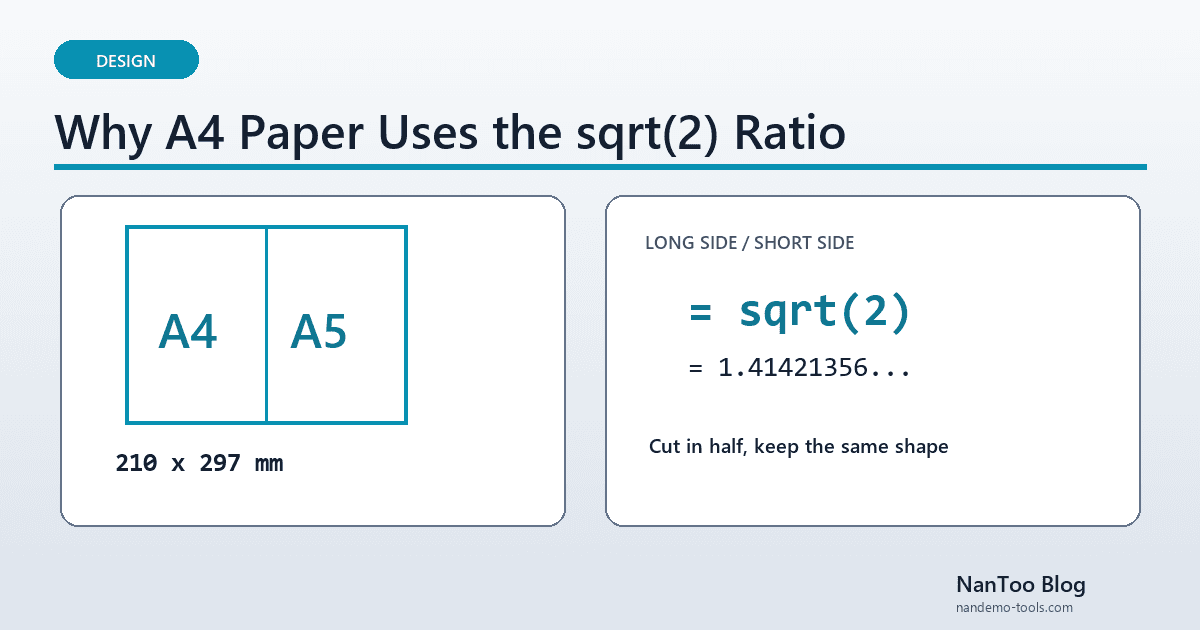
A4 measures 210 × 297 mm. Halve it across the long side and the theoretical result is 148.5 × 210 mm, close to the published A5 size of 148 × 210 mm. The design works because the unrounded rectangle has the aspect ratio √2:1. This article separates that geometry from integer-millimetre rounding and traces the historical steps that led to ISO 216.
Japanese original published: 2026-05-25
The √2 rectangle in Lichtenberg's 1786 letter
In October 1786, the German scientist Georg Christoph Lichtenberg wrote to Johann Beckmann about a sheet whose shape remained similar when halved. He calculated the ratio and observed that the writing paper in front of him already had approximately that proportion.
The letter is important evidence for the geometry and for an existing paper format, but it was not itself the modern ISO standard. Lichtenberg asked about the origin of the shape; later systems, legislation, industrial standards, and international standardisation were separate historical steps.
Why halving preserves the shape
Let the long side be a and the short side be b. After halving the long side, the new rectangle has sides b and a/2. Similarity requires:
a / b = b / (a / 2)
a² = 2b²
a / b = √2 ≈ 1.41421356
For a positive non-square rectangle, √2:1 is the unique aspect ratio that remains similar under this halving operation. The theoretical area halves and the linear scale between adjacent sizes is 1/√2.
From French law to DIN 476 and ISO 216
A French law of 1798 specified paper formats with dimensions that anticipate the metric, √2-based idea. Germany later standardised a systematic series as DIN 476 in 1922, associated with Walter Porstmann's work. The international A and B series were standardised as ISO 216 in 1975; the current ISO catalogue entry is ISO 216:2007.
These events should not be collapsed into a single invention. The mathematical observation, early legal dimensions, industrial series, and international standard each answer a different historical question.
A-series dimensions and millimetre rounding
The theoretical A0 rectangle has an area of 1 m² and an aspect ratio of √2:1. Successive sizes halve the area. Published ISO dimensions are rounded to whole millimetres, so their measured aspect ratios and areas are not mathematically exact.
Scroll horizontally if the table does not fit.
| Size | Dimensions | Area from published dimensions |
|---|---|---|
| A0 | 841 × 1189 mm | 0.999949 m² |
| A1 | 594 × 841 mm | about 0.4996 m² |
| A3 | 297 × 420 mm | 0.12474 m² |
| A4 | 210 × 297 mm | 0.06237 m² |
| A5 | 148 × 210 mm | 0.03108 m² |
This is why folding a physical 210 × 297 mm sheet gives 148.5 mm on one side while the nominal A5 width is 148 mm. The series preserves the theoretical relationship subject to the standard's rounding rules.
ISO, JIS, ANSI, and Letter are not interchangeable
Scroll horizontally if the table does not fit.
| Format | Dimensions | Aspect ratio |
|---|---|---|
| A4 | 210 × 297 mm | about 1.414 |
| US Letter | 8.5 × 11 in (215.9 × 279.4 mm) | about 1.294 |
| ISO B5 | 176 × 250 mm | about 1.420 |
| JIS B5 | 182 × 257 mm | about 1.412 |
The United States and Canada commonly use Letter paper. ASME Y14.1 defines engineering drawing sheet sizes and formats rather than replacing general office-paper conventions.
Japan's JIS P 0138 was established in 1951. Its current 1998 edition is identified as modified in relation to ISO 216:1975, and the JIS B series differs from the ISO B series. “B5” therefore needs a standard or region when exact dimensions matter.
Scaling, printing, and booklet layouts
For the unrounded A series, the theoretical adjacent-size scale factors are √2 ≈ 141.4% and 1/√2 ≈ 70.7%. Two size steps correspond to 200% or 50% in aspect-ratio-preserving linear scaling.
Whole-millimetre nominal sizes do not have exactly the same horizontal and vertical ratio, so one percentage cannot match both edges perfectly. Printer non-printable areas, margins, bleed, binding allowance, and application rounding also affect the result.
Placing two A5 pages on A4 is geometrically convenient, but the √2 ratio is not itself a guarantee that a PDF booklet feature needs no margin or imposition calculation.
Summary
- The theoretical A-series rectangle uses the aspect ratio √2:1.
- Whole-millimetre standard dimensions approximate, rather than exactly reproduce, the theoretical ratios and areas.
- Lichtenberg's 1786 letter recorded the geometry and an existing sheet; DIN 476 and ISO 216 were later standardisation steps.
- ISO 216 covers A and B sizes, while the envelope standard ISO 269 was withdrawn in 2009.
- ISO B, JIS B, A4, and US Letter must be distinguished in practical workflows.
References and sources
- ISO 216:2007 — Writing paper and certain classes of printed matter ↗
- DIN — Happy birthday, A4! ↗
- ISO 269:1985 — Correspondence envelopes (withdrawn in 2009) ↗
- Markus Kuhn, University of Cambridge — Lichtenberg's letter to Johann Beckmann ↗
- Markus Kuhn, University of Cambridge — International standard paper sizes ↗
- Japanese Standards Association — JIS P 0138:1998 ↗
- ANSI — Standard Paper Sizes: ISO and ANSI Formats ↗
Editorial note
This article was prepared with AI assistance and reviewed by an editor before publication. It may still contain factual errors, interpretation mistakes, or outdated information. Check the cited primary sources or official documentation before making an important decision.